SodaSlim Official Website › Blog › A Front Panel And No Numbers
SodaSlim Supplement Facts: What the Label Shows and What It Leaves Out
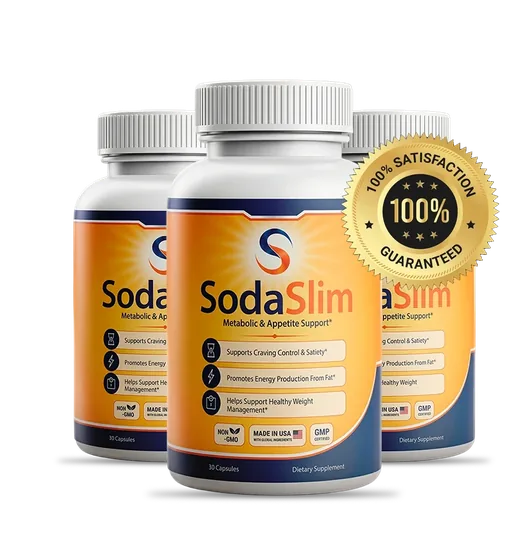
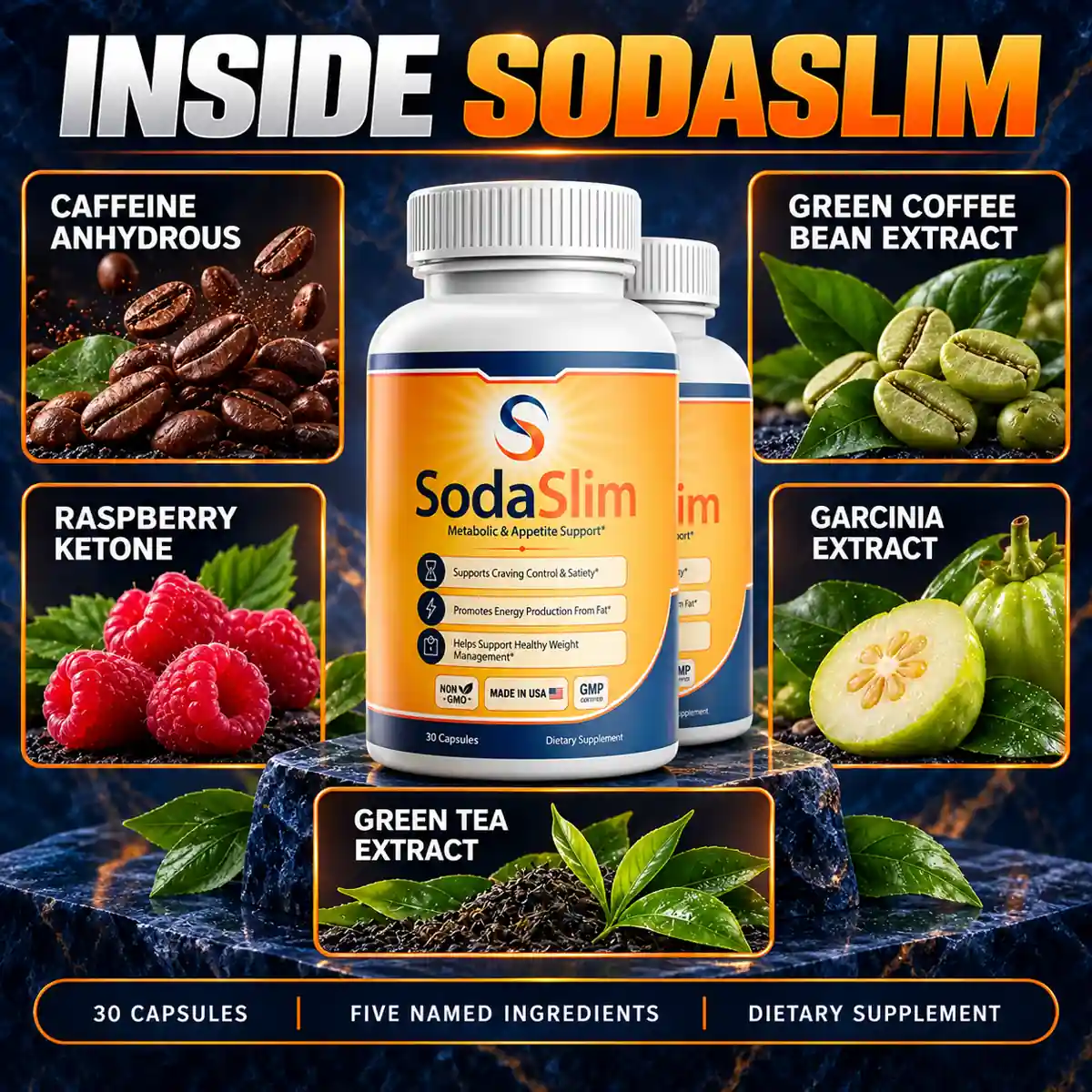
SodaSlim has no Supplement Facts panel on the label artwork the seller publishes. The front panel names five plants, caffeine anhydrous, green tea extract, green coffee bean extract, garcinia extract and raspberry ketone, and gives no amount for any of them. The label dose is one capsule a day, suggested in the morning, with 30 capsules in a bottle. If the bottle you receive prints a panel, it beats every figure on this page.
- A Supplement Facts panel is what lets a buyer compare a capsule against a trial. The artwork here carries a front panel only.
- The identity of the five plants is established. The quantities are known to the manufacturer and to nobody outside it.
- The honest substitute is to print the dose each published trial used and say whose figure it is.
- A missing panel is a limit on knowledge rather than evidence of bad faith, and treating it as either extreme is a mistake.
- The bottle you receive beats every website, including this one.
What a Supplement Facts panel actually does
It is a small table, usually on the back or the side of a bottle, and it carries one thing no other part of a label carries: quantities. Serving size, servings per container, and then each ingredient with the amount per serving beside it.
The reason that table is the most valuable text on any supplement is that the research in this field is dosed. A trial does not test green coffee bean extract; it tests a specific amount of chlorogenic acid for a specific number of weeks. Without a quantity on the bottle, the trial and the capsule cannot be placed beside each other at all.
| What a panel would tell you | What a front panel alone tells you |
|---|---|
| The amount of each ingredient per capsule | Which ingredients are present, in descending order of nothing |
| Whether a dose approaches the one a trial used | That a trial exists, somewhere, using the same plant |
| How much caffeine to subtract from the day's total | That caffeine is present |
| Whether an extract is standardised, and to what | The plant's common name |
| Whether the formula could plausibly work as claimed | What the claims are |
The right-hand column is not nothing. It is considerably less than the left-hand column, and the gap is the subject of this piece.
The right-hand column of that table is what this bottle offers. It answers every question about identity and none about quantity, which means a reader can say with confidence what plants are involved and nothing at all about whether they are present in amounts anybody has studied.
What a front panel still establishes
More than people assume, and it is worth listing before the criticism, because a page that leads with the gap will leave a reader believing the bottle is emptier than it is.
It establishes the ingredient list. Five plants: caffeine anhydrous, green tea extract, green coffee bean extract, garcinia extract and raspberry ketone. That list is what makes the rest of the research readable, because each of those plants has a literature a reader can go and check.
It establishes the claims. Four printed statements, all of them structure and function statements rather than treatment claims, and all four modest by the standards of the category.
It establishes the form and the count. A capsule, thirty to a bottle, one a day, taken in the morning. That is a complete routine, and the hour is more than most labels specify.
And it establishes the marks: non-GMO, made in the USA with global ingredients, GMP certified. Those describe a process rather than a result, which is a distinction worth keeping, but they are not nothing.
The honest substitute: trial doses
If a website cannot print what is in the capsule, the next best thing it can do is print what the research gave people, attribute each figure to its trial, and let a reader hold the two ideas at once.
| Plant | Dose used in its research | What that dose came from |
|---|---|---|
| Caffeine anhydrous | Roughly 100 to 600 mg a day across trials | The pooled weight literature; 400 mg a day is the safety ceiling |
| Green tea extract | 90 mg of EGCG three times daily | The 24-hour respiratory chamber trial |
| Green coffee bean extract | At least 500 mg a day of chlorogenic acid | The 2023 meta-analysis of pooled randomised trials |
| Garcinia extract | 1,500 mg a day of hydroxycitric acid | The twelve-week randomised trial published in JAMA |
| Raspberry ketone | No human dose exists | The published work is in mice, at 165 to 500 mg per kilogram |
Every figure in the middle column belongs to a trial. None of them describes this capsule, and printing them beside it is the closest an honest page can get to the panel that is not there.
Two of those numbers are large enough to be interesting. Five hundred milligrams a day of chlorogenic acid is the level at which pooled trials found a mean difference of about 1.3 kg against placebo in a 2023 meta-analysis. Fifteen hundred milligrams a day of hydroxycitric acid is what the twelve-week garcinia trial gave, and it separated from placebo on nothing in JAMA.
A single capsule holding five ingredients cannot carry trial-sized amounts of all of them. That is arithmetic about volume rather than a criticism of the formula, and it is true of almost every multi-ingredient capsule in this category. What the missing panel prevents is knowing which of the five was prioritised.
A safety assessment proposed 300 mg of EGCG a day as a ceiling for supplements on hepatic grounds, and 400 mg a day is the commonly cited caffeine ceiling for healthy adults from the safety reviews. Both are numbers a buyer would want to check a capsule against, and both are unreachable without a panel.
Order SodaSlim with the trial doses printed beside it
Every plant on that panel is set out on this website with the dose its own research used, attributed to the trial that used it. The window behind the purchase runs sixty days.
From $49 a bottle on six, $79 on two · 60 days to send it back
Go To The SodaSlim CheckoutThirty capsules · one each morning · batch SOD-26/SO-8573
Where the gap matters most
Not evenly. There are three situations where a missing panel changes a decision, and a great many where it does not.
It matters most for the caffeine. Anyone whose day already runs to three or four coffees is close to the commonly cited ceiling, and an unmeasured stimulant cannot be fitted into that total. For that person the missing figure is decisive, and the right answer is a different formula rather than a careful one.
It matters for anyone comparing two bottles. A panel is what makes a comparison evidential rather than aesthetic, and without one the comparison falls back on the identity of the plants and the terms of sale.
It matters least for somebody who has decided to try the category on its own terms and has a return window long enough to do so. That buyer is not going to check a milligram figure against a meta-analysis anyway; they are going to take it for a month and see. For them the terms of the guarantee carry more weight than the panel would.
Being fair about how common this is
A great many supplements in this category print complete panels and a great many do not. The absence of one is a limit on what can be known rather than evidence that anything is being hidden, and a page that treated it as proof of bad faith would be overstating its own evidence.
There is a related point worth making in the other direction. A printed panel is not a laboratory result either. An analysis of herbal and dietary supplements implicated in liver injury found their contents frequently did not match their labels in a chemical study, which means the panel is the best document a buyer has rather than a guarantee.
So the honest ranking is: a published certificate of analysis beats a printed panel, a printed panel beats a front panel, and a front panel beats a website. The bottle in your hand outranks this page in every case.
What a buyer can actually do
- Read the bottle that arrives rather than trusting any website, including this one, and treat the label as the more recent document.
- If a Supplement Facts panel is printed on the back, use it, and consider telling this desk so these pages can be corrected.
- Count the rest of the day's caffeine and leave room for an unknown rather than trying to complete an arithmetic that cannot be completed.
- Weigh the terms of sale more heavily than usual, since they are the part of this offer that can be checked in advance.
- Judge the month rather than the week, because the plants whose doses cannot be checked are also the ones that need four weeks before any research attaches to them.
A front panel establishes what is in the bottle and not how much. The workaround is to print what each trial used, say whose figure it is, and let the return window carry the risk the panel would otherwise have removed.
References
- Navarro V, Avula B, Khan I, et al. The contents of herbal and dietary supplements implicated in liver injury in the United States are frequently mislabeled. Hepatol Commun. 2019;3(6):792-794. PMID 31168513. https://pubmed.ncbi.nlm.nih.gov/31168513/
- Kanchanasurakit S, Saokaew S, Phisalprapa P, Duangjai A. Chlorogenic acid in green bean coffee on body weight: a systematic review and meta-analysis of randomized controlled trials. Syst Rev. 2023;12(1):163. PMID 37710316. https://pubmed.ncbi.nlm.nih.gov/37710316/
- Heymsfield SB, Allison DB, Vasselli JR, et al. Garcinia cambogia (hydroxycitric acid) as a potential antiobesity agent: a randomized controlled trial. JAMA. 1998;280(18):1596-600. PMID 9820262. https://pubmed.ncbi.nlm.nih.gov/9820262/
- Dekant W, Fujii K, Shibata E, Morita O, Shimotoyodome A. Safety assessment of green tea based beverages and dried green tea extracts as nutritional supplements. Toxicol Lett. 2017;277:104-108. PMID 28655517. https://pubmed.ncbi.nlm.nih.gov/28655517/
- Wikoff D, Welsh BT, Henderson R, et al. Systematic review of the potential adverse effects of caffeine consumption in healthy adults, pregnant women, adolescents, and children. Food Chem Toxicol. 2017;109(Pt 1):585-648. PMID 28438661. https://pubmed.ncbi.nlm.nih.gov/28438661/