SodaSlim Official Website › A checklist
A checklistChoosing A Metabolism Supplement: Eight Questions For Any Bottle
Eight questions separate a well-documented metabolism supplement from a thinly documented one, and none of them is about the marketing.
They cover what is printed on the label, whether the claims match the ingredients, what the dosing schedule asks of a buyer, and what happens if the bottle turns out not to suit them. All eight are then turned on the product this website sells, in the closing section.
Scoring a product against a checklist published on its own website is only worth doing if the failures are reported as failures, so they are.
The eight questions
Is a Supplement Facts panel printed on the bottle?
The single most useful line of text on any supplement. It names each ingredient and the amount per serving, which is what lets a buyer compare a capsule against a trial. Without it, the identity of the ingredients is established and the quantities are not.
Are the extracts standardised, and to what?
Green tea extract is dosed in the research by its catechin content and green coffee by its chlorogenic acid. An extract without a standardisation figure could be anywhere on a very wide range, and the trials cannot be applied to it.
Does it print a caffeine content?
If the formula contains a stimulant, this is the number that determines whether it can safely be added to a day that already contains coffee. The commonly cited ceiling is 400 mg a day from all sources for healthy adults, and an unmeasured contribution cannot be fitted into it.
Does the claim match the ingredients?
Read the panel, then read the claims. A bottle whose marketing describes effects on gut bacteria, lean muscle or detoxification, with no probiotic, no protein and nothing that could plausibly do either on the panel, is claiming past its own formula.
How many ingredients, and at what cost to each?
A capsule is a fixed volume. Five ingredients in one capsule cannot each carry a trial-sized dose, and a formula naming fifteen has either very small amounts of most of them or a very large capsule.
What does the dosing schedule ask of you?
One capsule a day is the easiest regimen there is to keep. Three capsules at three different times is the hardest, and adherence is the variable with the largest effect on whether any of this works.
What does the return window actually cover?
Look for three things: the length, whether opened bottles are included, and who pays return postage. A window that excludes opened bottles is worthless on a supplement, since an unopened bottle answers no question.
Can the seller trace what they sold you?
A batch reference, a telephone number and somebody who can match a bottle to a production run. This is the difference between a retail channel and a listing, and it costs nothing extra.
Why the panel question comes first
Because every other judgement depends on it. The pooled trials in this field are dosed precisely: 500 mg a day of chlorogenic acid in the green coffee meta-analysis, 1,500 mg a day of hydroxycitric acid in the garcinia trial, 90 mg of EGCG three times daily in the chamber trial. Those numbers are the whole value of the research, and a bottle that prints no amounts cannot be compared with any of them.
It is worth being fair about how common this is. A great many supplements in this category print full panels, and a great many do not. The absence of one is a limit on what a buyer can know rather than evidence that anything is wrong, and treating it as proof of bad faith would be as unreasonable as ignoring it.
What a reader can do instead is weigh the rest of the list more heavily. Missing a panel while carrying a long window, a traceable run and somebody who answers a telephone is a materially different offer from missing a panel with nothing standing behind it.
Two questions people ask that are less useful than they look
How many ingredients does it have? More is not better in a fixed capsule volume, and a long list often means each ingredient is present in an amount no trial has ever tested. Five well-chosen plants beat fifteen token ones, and the question that matters is the amounts rather than the count.
Is it natural? The term has no regulated definition in United States supplement labelling, and it carries no information about safety. Two of the ingredients discussed throughout this guide, concentrated green tea extract and garcinia, have published hepatic case literatures in a clinical series, and both are plant-derived. Natural and safe are different words.
A third question is worth adding rather than discarding: what does the seller say that the label does not? Marketing that reaches beyond the printed claims is the most reliable signal in this category, because it shows where the seller is willing to go when nobody is checking.
The eight questions applied to SodaSlim
| Question | This product | What that means |
|---|---|---|
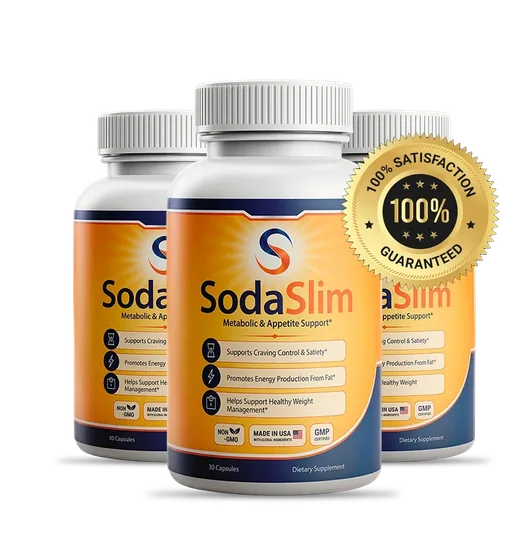
| Supplement Facts panel | Not printed on the artwork the seller publishes | The largest gap, and the reason every ingredient section on this website prints trial doses instead |
| Standardisation figures | Not published by the seller | Applies to both extracts, and follows from the first row |
| Caffeine content | Named on the panel, no figure given | Means the day's caffeine arithmetic cannot be completed |
| Claims matched to ingredients | On the bottle, yes | The four printed statements are modest and proportionate. The seller's wider material is not, and this desk declined to follow it |
| Ingredient count | Five in one capsule | Reasonable for the category, and it does mean no single plant can carry a trial-sized dose |
| Dosing schedule | One capsule, once daily, in the morning | The best answer available, and the label names the hour, which is unusual and useful |
| Return window | 60 days, opened bottles included, buyer pays postage | Strong. Twice the length of one bottle, which matters on a formula whose slower plants need four weeks |
| Traceability | Batch reference and a telephone order desk | Good, and it is the argument for buying through the official channel |
Two clear failures, two partial answers and four strong results. Publishing that on the website that sells the product is the point of the exercise.
The pattern is consistent and it is worth naming. This product is strong on everything that concerns the transaction, which is the routine, the return window and the traceability, and weak on everything that concerns verification, which is the panel and the standardisation.
For a buyer, that suggests a specific way to approach it. The questions this bottle answers badly are questions the return window can partly compensate for: a person who cannot check a dose in advance can at least test the formula for a month and send it back. The questions it answers well are the ones that make that test possible.
A different bottle, with a printed panel and a fourteen-day window that excluded opened product, would score the reverse and would be the harder purchase to justify.
What to do with the answers
Rank the eight by what matters to your own situation rather than treating them equally. Somebody who already drinks four coffees a day should weight the caffeine question above everything else, because an unmeasured stimulant is the one item on this list that can cause an actual problem.
Somebody comparing two similar bottles should weight the panel question, because it is the only one that lets a comparison be made on evidence rather than on presentation.
And somebody buying their first supplement in this category should weight the return window and the traceability, because the most likely outcome of a first purchase is discovering that the category is not what they expected, and the terms of sale are what decide how expensive that discovery is.
Who publishes this SodaSlim website?
- Kanchanasurakit S, Saokaew S, Phisalprapa P, Duangjai A. Chlorogenic acid in green bean coffee on body weight: a systematic review and meta-analysis of randomized controlled trials. Syst Rev. 2023;12(1):163. PMID 37710316. https://pubmed.ncbi.nlm.nih.gov/37710316/
- Gorji Z, Varkaneh HK, Talaei S, et al. The effect of green-coffee extract supplementation on obesity: a systematic review and dose-response meta-analysis of randomized controlled trials. Phytomedicine. 2019;63:153018. PMID 31398662. https://pubmed.ncbi.nlm.nih.gov/31398662/
- Heymsfield SB, Allison DB, Vasselli JR, et al. Garcinia cambogia (hydroxycitric acid) as a potential antiobesity agent: a randomized controlled trial. JAMA. 1998;280(18):1596-600. PMID 9820262. https://pubmed.ncbi.nlm.nih.gov/9820262/
- Vuppalanchi R, Bonkovsky HL, Ahmad J, et al. Garcinia cambogia, either alone or in combination with green tea, causes moderate to severe liver injury. Clin Gastroenterol Hepatol. 2022;20(6):e1416-e1425. PMID 34400337. https://pubmed.ncbi.nlm.nih.gov/34400337/
- Dulloo AG, Duret C, Rohrer D, et al. Efficacy of a green tea extract rich in catechin polyphenols and caffeine in increasing 24-h energy expenditure and fat oxidation in humans. Am J Clin Nutr. 1999;70(6):1040-5. PMID 10584049. https://pubmed.ncbi.nlm.nih.gov/10584049/
- Dekant W, Fujii K, Shibata E, Morita O, Shimotoyodome A. Safety assessment of green tea based beverages and dried green tea extracts as nutritional supplements. Toxicol Lett. 2017;277:104-108. PMID 28655517. https://pubmed.ncbi.nlm.nih.gov/28655517/
- Wikoff D, Welsh BT, Henderson R, et al. Systematic review of the potential adverse effects of caffeine consumption in healthy adults, pregnant women, adolescents, and children. Food Chem Toxicol. 2017;109(Pt 1):585-648. PMID 28438661. https://pubmed.ncbi.nlm.nih.gov/28438661/
- Navarro V, Avula B, Khan I, et al. The contents of herbal and dietary supplements implicated in liver injury in the United States are frequently mislabeled. Hepatol Commun. 2019;3(6):792-794. PMID 31168513. https://pubmed.ncbi.nlm.nih.gov/31168513/
- Dietary Supplements for Weight Loss: Fact Sheet for Consumers. National Institutes of Health, Office of Dietary Supplements. https://ods.od.nih.gov/factsheets/WeightLoss-Consumer/
- Questions and Answers on Dietary Supplements. U.S. Food and Drug Administration. https://www.fda.gov/food/information-consumers-using-dietary-supplements/questions-and-answers-dietary-supplements
Order SodaSlim with the checklist already applied
Eight questions, two clear failures and four strong results, published above on the website that sells it. The window behind the purchase runs sixty days, which is what makes the failures survivable.
From $49 a bottle on six, $79 on two · 60 days to send it back
Go To The SodaSlim CheckoutThirty capsules · one each morning · batch SOD-26/SO-8573