SodaSlim Official Website › Reading the marks
Reading the marksSodaSlim Testing And Quality: What The Marks Actually Certify
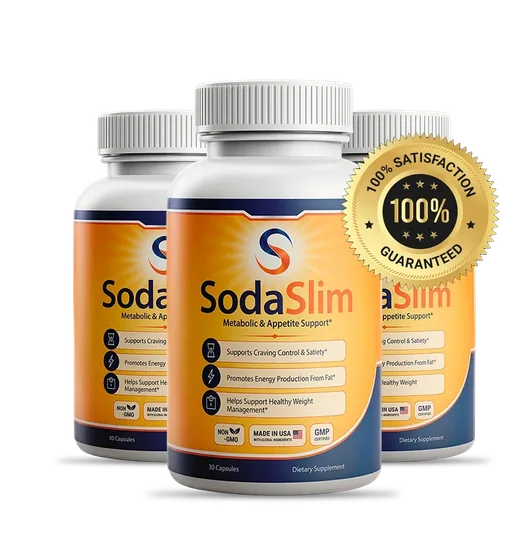
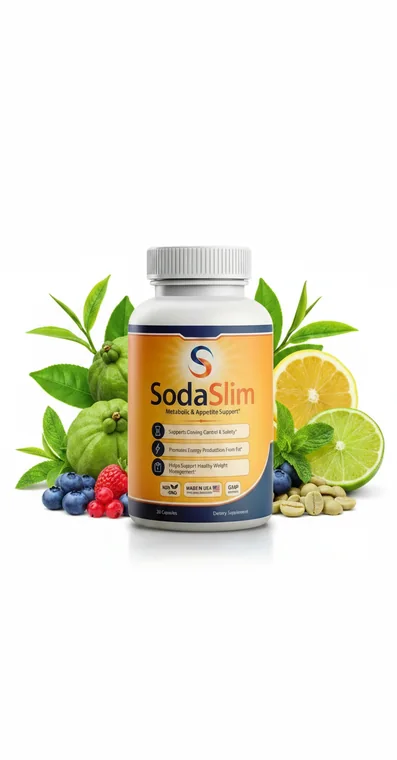
Eight marks appear around this product and three of them are printed on the bottle itself: non-GMO, made in the USA with global ingredients, and GMP certified.
Each one is read below for what it certifies and what it leaves open. None of them speaks to how much of any plant is in the capsule, because that is a question only a Supplement Facts panel or a published certificate can answer.
A mark on a label is a claim about a process. Treating it as a claim about a result is the most common way buyers in this category overestimate what they know.
The eight SodaSlim marks, one at a time
 Made in the USAManufactured in the United States with globally sourced ingredients, which is exactly what the front panel says and is a statement about where assembly happens rather than about where every plant grew.
 GMP certifiedGood Manufacturing Practice is the quality system United States supplement production runs under. It governs process, record-keeping and cleanliness rather than whether a formula works.
 Registered facilityRegistration with the regulator means the facility has filed as a producer. It is a registration, not an approval of this formula or of any claim made for it.
 Non-GMONo genetically modified material, the third of the three marks printed along the bottom of this label.
 All naturalAn all-natural mark. The term has no regulated definition in United States supplement labelling and is best read as a description of intent.
 Gluten freeNo gluten-containing grain in the formula, which matters to anyone avoiding it and is otherwise a neutral fact.
 Vegetarian friendlySuitable for a vegetarian diet. Nothing on the artwork addresses whether the capsule shell itself is plant-derived.
 Physician formulatedA physician-formulated mark. The artwork names no clinician, gives no credentials and cites no review, so this is a claim about origin rather than a claim about evidence.
What the SodaSlim marks do not establish
Three things, and they are the three a buyer most wants to know.
They do not establish the quantity of any ingredient. GMP certification means a facility follows documented procedures and keeps records; it does not publish what went into a capsule. The front panel of this bottle names five plants and gives amounts for none, and no mark on it changes that.
They do not establish efficacy. A registered facility can manufacture a formula with no evidence behind it exactly as reliably as one with a great deal, and registration is neither an endorsement nor a review. The evidence for these five plants is on the ingredients page, with the dose each trial used.
And the physician-formulated mark does not name a physician. There is no clinician's name on the artwork, no credentials and no published review, which makes it a statement about the formula's origin rather than about its scrutiny. Saying so is the job of a page like this one.
What GMP certification means for a SodaSlim capsule
It is the mark most often misread on a supplement label, so it is worth setting out precisely. Good Manufacturing Practice is a system of documented procedure: who did what, with which equipment, cleaned how, recorded where. A certified facility can demonstrate that its process is controlled and its records are complete.
What that buys a buyer is real. It makes cross-contamination less likely, it makes an unrecorded substitution less likely, and it means somebody could reconstruct what happened during a production run if they had to. On a category with a documented history of contents not matching labels in published analyses, process control is not a trivial thing to have.
What it does not buy is any statement about the formula. GMP says nothing about whether five plants in one capsule is a sensible design, whether the amounts inside approach the ones the research used, or whether the product does what the panel claims. A perfectly controlled process can produce a capsule with very little in it.
The same distinction applies to facility registration. Registering as a producer is an administrative step, not a review of any product made there, and no supplement in the United States is approved by the regulator before sale. The FDA publishes its own consumer guidance on exactly this point for anyone using supplements.
Where SodaSlim sits against a fully documented label
| Document | On this bottle | What it would settle |
|---|---|---|
| Front panel with named ingredients | Present | Which plants are in the formula, which is established |
| Supplement Facts panel with amounts | Not printed on the artwork the seller publishes | Whether any plant is present at a dose the research used |
| Standardisation figures for the extracts | Not published by the seller | How much chlorogenic acid and catechin the capsule actually carries, which is what trials are dosed against |
| Published certificate of analysis | A reference string only | What an assay found in a specific production run |
| Independent third-party testing | Nothing published | Whether the contents match whatever the label states |
| Named formulator behind the physician mark | No name on the artwork | Who stands behind the formula and on what expertise |
Three of these six are common on direct-sold supplements and three are not. Their absence is a limit on what can be known rather than evidence that anything is wrong.
That table is the honest summary of this page and the reason the marks above are read so carefully. A bottle with the second row filled in could be compared line by line with the trials cited across this website. This one has to be judged on the identity of its plants, the terms of its return window, and the traceability of its production run, which is what the rest of this cluster is about.
What would raise confidence in SodaSlim beyond these marks
- A Supplement Facts panel printed on the bottle, naming each plant and the milligrams per capsule.
- A published certificate of analysis for the run, with the assay results attached rather than a reference string.
- Third-party testing by an independent laboratory, published rather than cited.
- A named formulator with published credentials standing behind the physician-formulated mark.
- Standardisation figures for the two extracts, since the chlorogenic acid and catechin content is what the research is dosed against.
None of those is unusual in this category and several are common. Their absence is not evidence of a problem, and their presence would move this product from one that has to be judged on the identity of its plants to one that could be checked against the literature line by line.
Any one of them arriving would be written into these pages and dated underneath. Anyone holding a bottle that carries more than the artwork here describes is invited to say so at contact@Sodeaslim.com.
How SodaSlim quality marks compare with the category
Three marks printed on a front panel is typical for a direct-sold supplement, and this one carries the common three. The broader set of eight that appears around the product in the seller's own material is also typical, and in this category such badge rows are assembled for reassurance as much as for information.
What separates a well-documented bottle from a thinly documented one is rarely the badges. It is whether a panel of amounts is printed, and whether anything independent has been published about the contents. On the first of those this artwork is silent; on the second, nothing has been published either way.
Unflattering, and accurate, and placed here deliberately: a page that exists to audit the marks is where such a summary belongs, rather than dripped through every page that describes the capsule.
Who publishes this SodaSlim website?
- Navarro V, Avula B, Khan I, et al. The contents of herbal and dietary supplements implicated in liver injury in the United States are frequently mislabeled. Hepatol Commun. 2019;3(6):792-794. PMID 31168513. https://pubmed.ncbi.nlm.nih.gov/31168513/
- Dekant W, Fujii K, Shibata E, Morita O, Shimotoyodome A. Safety assessment of green tea based beverages and dried green tea extracts as nutritional supplements. Toxicol Lett. 2017;277:104-108. PMID 28655517. https://pubmed.ncbi.nlm.nih.gov/28655517/
- Questions and Answers on Dietary Supplements. U.S. Food and Drug Administration. https://www.fda.gov/food/information-consumers-using-dietary-supplements/questions-and-answers-dietary-supplements
- Green Tea. National Center for Complementary and Integrative Health, National Institutes of Health. https://www.nccih.nih.gov/health/green-tea
Order SodaSlim with the marks read for what they say
Three printed marks, five named plants and a sixty-day window. That is the honest inventory, and the window is the part that carries the most weight for a first-time buyer.
From $49 a bottle on six, $79 on two · 60 days to send it back
Go To The SodaSlim CheckoutThirty capsules · one each morning · batch SOD-26/SO-8573